
Laptop until lunch, bike from two o'clock. That was the whole plan for a week in Puglia in the middle of September, and I will be honest about how it came together: it was a last-minute booking, I knew close to nothing about the region, and the whole thing was built around one cycle path I had read about.
It worked anyway. The base was an Airbnb in the countryside near Cisternino, out in Contrada Marangiulo, where the Valle d'Itria is all drystone walls, olive groves and trulli. From there I rode three afternoons, spent half a day in Matera, and finished with a night in Lecce before the flight out of Brindisi. Puglia turned out to be forgiving of a plan that barely existed, which is most of what I want to tell you here.
Why the Valle d'Itria works as a base
I did do one piece of research, and it decided everything else. I found the Ciclovia dell'Acqua, the traffic-free path that runs along the line of the Apulian aqueduct, and then looked for somewhere to stay near it. That was the extent of the plan. Everything in this post follows from picking a base off a single cycle path.
It was a better decision than it deserved to be. The obvious instinct is to book somewhere on the coast. I would argue against it. The Adriatic side of Puglia is busy, flat and strung out along a single road, and the good riding starts where the land steps up onto the Murgia plateau, fifteen kilometres inland.
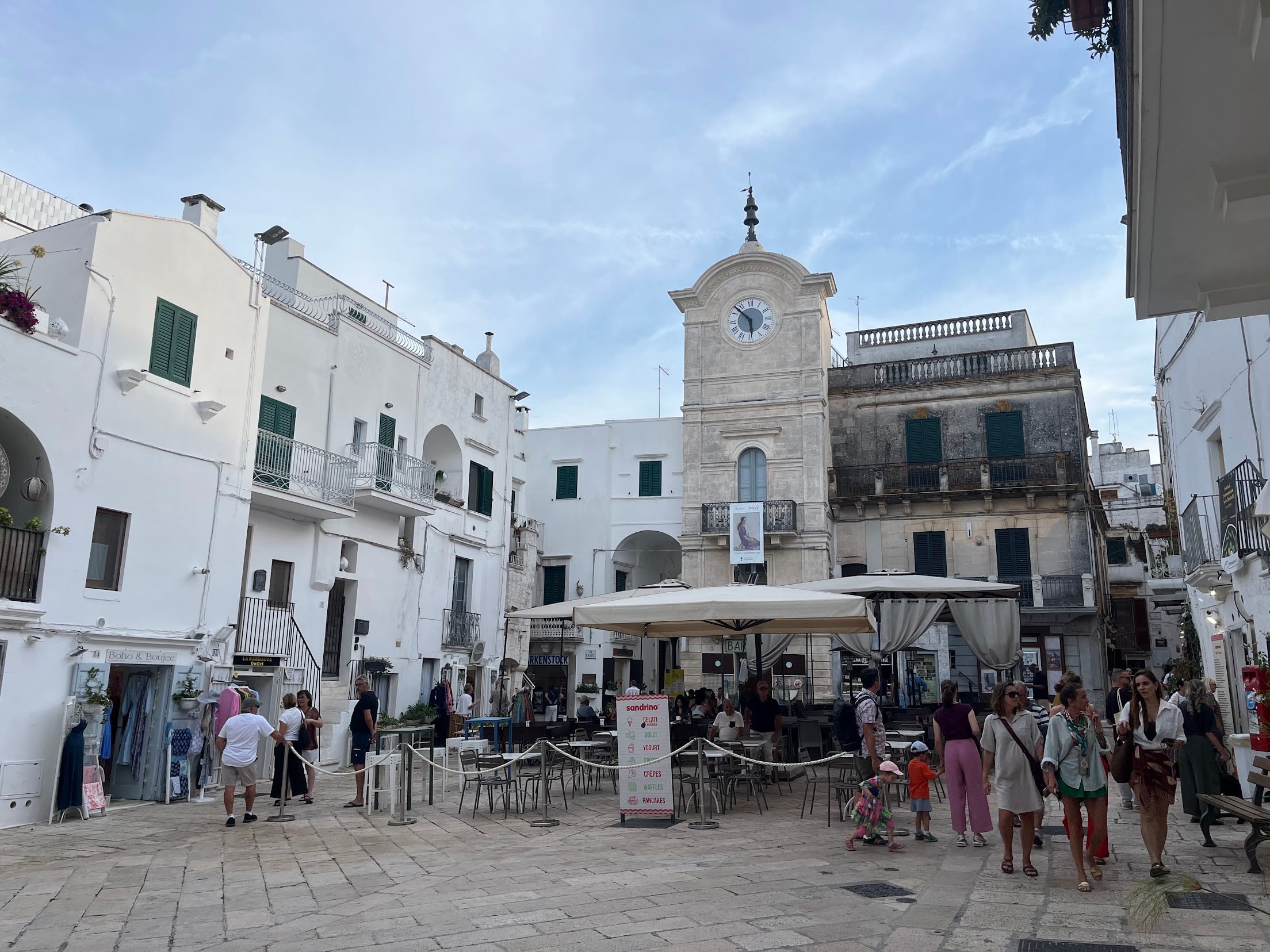
Cisternino sits right on that step. The whitewashed old town is perched on the edge of the escarpment with the olive plain and the sea laid out below it, and everything I wanted was within half an hour of riding: Locorotondo and Martina Franca to the west, Ostuni and Ceglie Messapica to the east, Alberobello just up the road, and the coast a long descent away. The lanes between them are narrow, quiet, and mostly walled in on both sides. You rarely see a car.
The trade-off is that the countryside here is genuinely rural. Our place had decent wifi, but that is not a given, and I would check it before booking anything if you actually need to work. The nearest proper supermarket was a ten-minute drive. Out here, a car is the only thing that really makes sense.
The rhythm of a workation
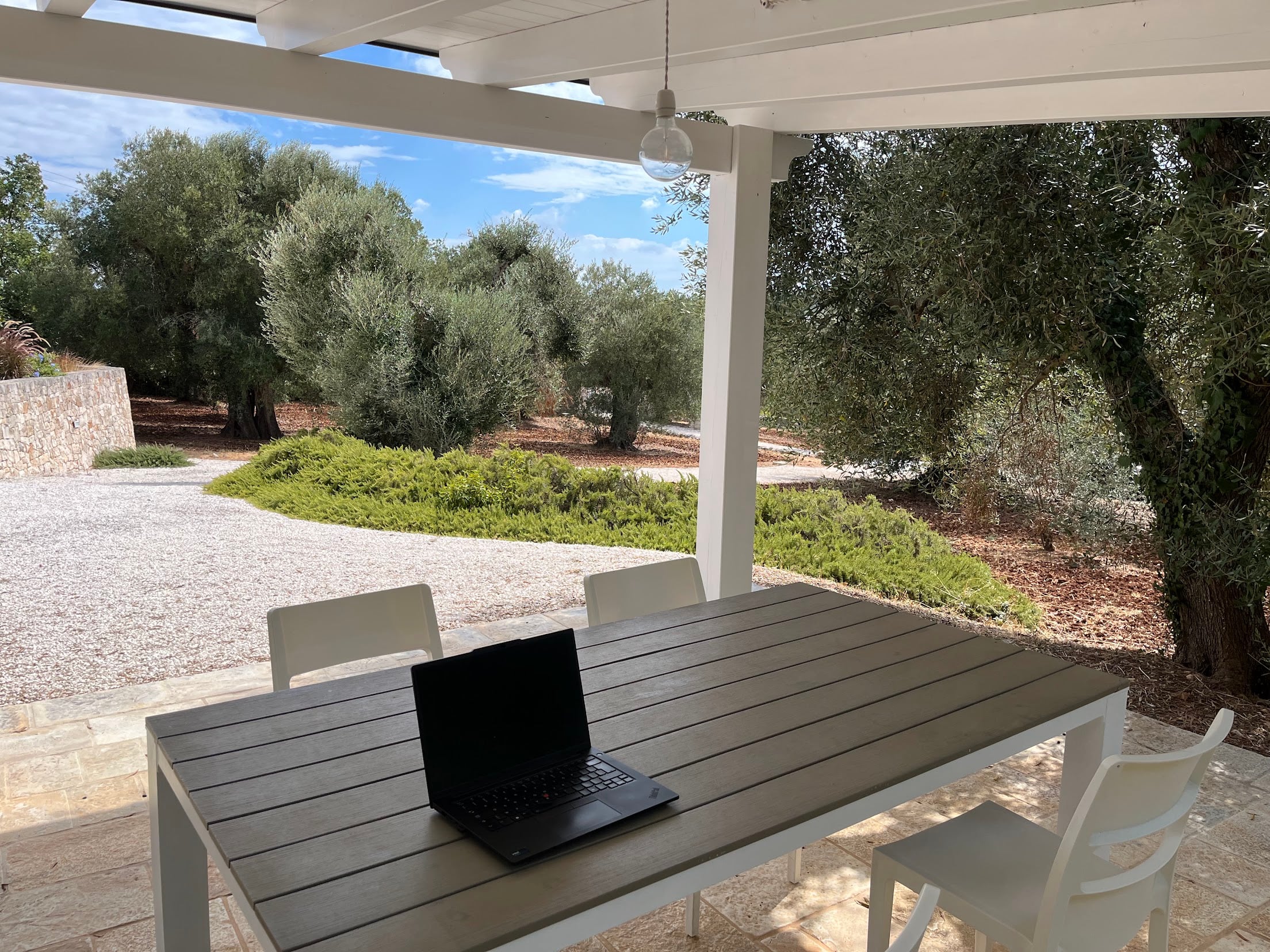
Mornings at the table, afternoons on the bike. It sounds simple, and it mostly was, but the half-day format quietly changed how I chose routes. Nothing over three hours. No point-to-point adventures that needed a lift home. No riding into the dark.
What that leaves you with is loops of forty to fifty kilometres, and the Valle d'Itria is almost perfectly built for that. There are no long climbs here, but there is barely any flat either. The plateau is a constant series of short ramps between olive groves, and the one real bit of elevation is the escarpment itself, which drops around 380 metres to the coast and has to be climbed back up if you go down it.
September afternoons are still warm, and that shapes the riding more than the distances do. Two o'clock in 30 degrees is fine on the shaded lanes between the drystone walls and noticeably less fine on an exposed gravel drag, so it is worth a thought about which half of a loop you do first.
Renting a bike: Probike in Monopoli
I did not bring a bike. For a week where riding is the afternoon activity rather than the point of the trip, dragging a bike bag through an airport and rebuilding it in a rental car park is a lot of work for very little gain.
Instead I rented a gravel bike from Probike in Monopoli, about half an hour's drive from Cisternino, and it was easily the best logistical decision of the week. The shop is owned by a former professional and run day to day by Isabella, who was patient, genuinely friendly, and happy to talk through where to actually ride rather than just handing over a bike and a map. The whole thing took twenty minutes.
Worth knowing if you are planning something similar: book ahead, and be specific about what you intend to ride. A good chunk of the best riding around here is unsurfaced, and the tyre choice matters more than the bike does.
The three rides
Three afternoons, three loops, all starting from the front door. Together they cover most of what the area has to offer: traffic-free gravel, the descent to the sea, and the rougher stuff on the escarpment.

The reason I booked the trip, and still the one I would recommend first. From Contrada Marangiulo up through Cisternino and onto the Ciclovia dell'Acqua, a traffic-free gravel path that runs ever so slightly downhill past the Galante bridge and an absurd number of trulli all the way to Ceglie Messapica. The way back is the harder half: narrow broken lanes and gravel north through the olive groves. Hilly the whole way, but apart from one steep section on patchy gravel it stays comfortably doable.
👉 Check out this post to learn more about this ride.

A popular Komoot mountain bike loop that drops off the escarpment towards Ostuni, past Santa Maria di Agnano and the Sant'Oronzo sanctuary, on red dirt roads through old olive groves with the white city and the coast in view. It is also considerably more adventurous than advertised. There is a good 10 to 15 km of pushing on overgrown and rocky trail in here. Know what you are pointing a gravel bike at before you start it, and give yourself more daylight than the distance suggests.
👉 Check out this post to learn more about this ride.

The one that actually reaches the Adriatic. Quiet lanes between drystone walls drop 380 metres past the Dolmen di Montalbano into the olive plain, then out to the beaches and dunes of the Parco Naturale Regionale Dune Costiere at Pilone. A bit of everything underwheel: good tarmac, bad tarmac, gravel, dirt and sand. The sting is in the tail, because the sea is the low point of the route and getting home means a long gravel drag through Speziale and then 2.4 km at 7% back up the escarpment to Caranna.
👉 Check out this post to learn more about this ride.
The towns on your doorstep
Part of the appeal of this corner of Puglia is that the sightseeing does not need a day set aside for it. Most of these are an evening, or a coffee stop halfway round a ride.
- Cisternino is the one I kept going back to. A compact whitewashed old town, a terrace on the edge of the escarpment looking down over the plain, and a local tradition of butchers who grill your meat for you on the spot.
- Locorotondo is ten minutes away and every bit as good: a circular hilltop centre of white houses with steep pitched roofs, and a view back across the whole valley.
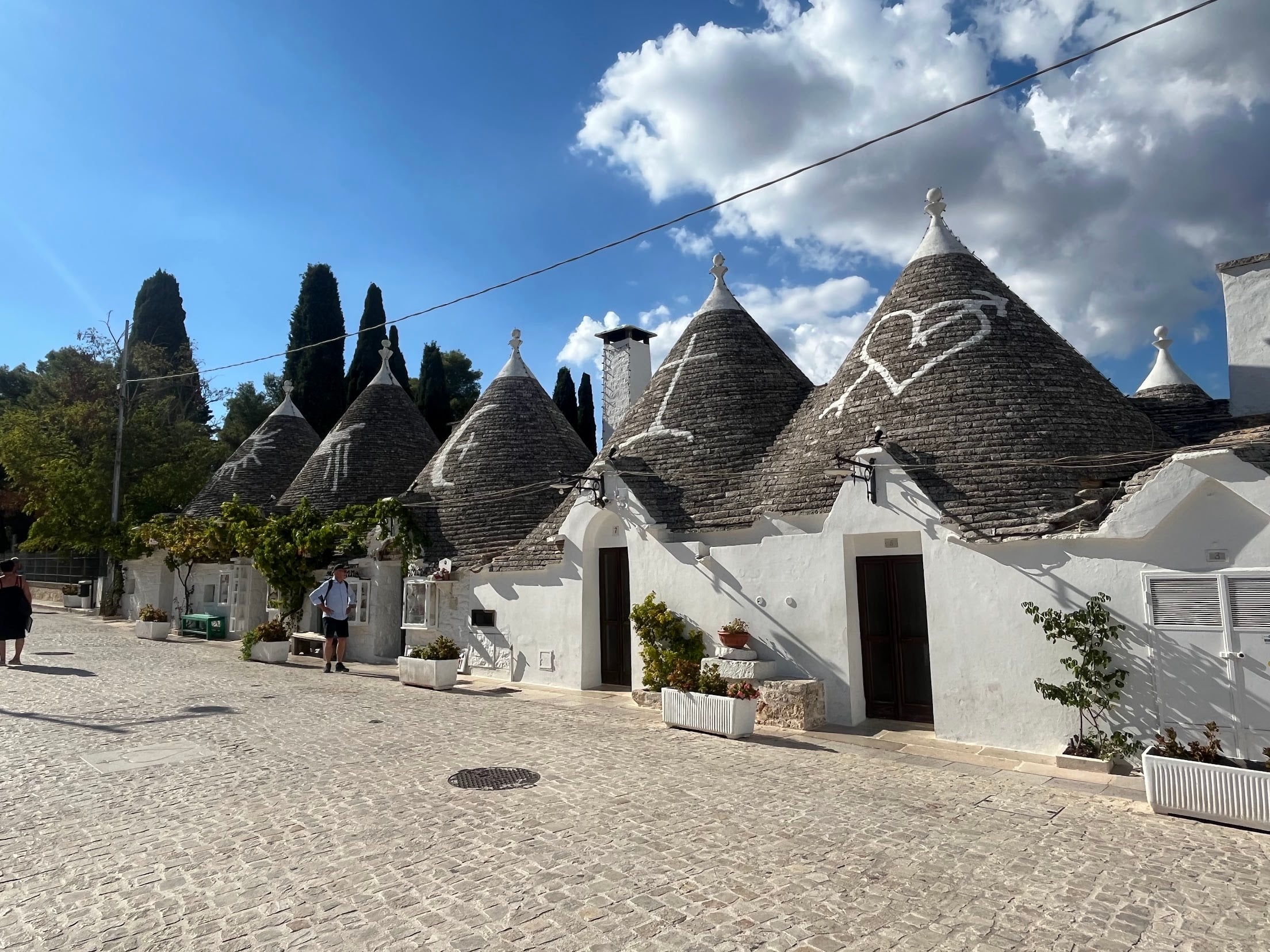
- Alberobello is the famous one, with whole streets of trulli and UNESCO status to go with them. Look up and you will see white symbols painted on the stone roofs, and nobody entirely agrees on what they mean. It is also by far the busiest place in the area. Go early or go late.
- Ostuni, Martina Francaand Ceglie Messapica round out the set, and all three sit on or near one of the rides above.
Half a day in Matera
Matera is not in Puglia at all, it is over the border in Basilicata, but it is only around 75 kilometres from Cisternino and it is the one detour I would not skip.
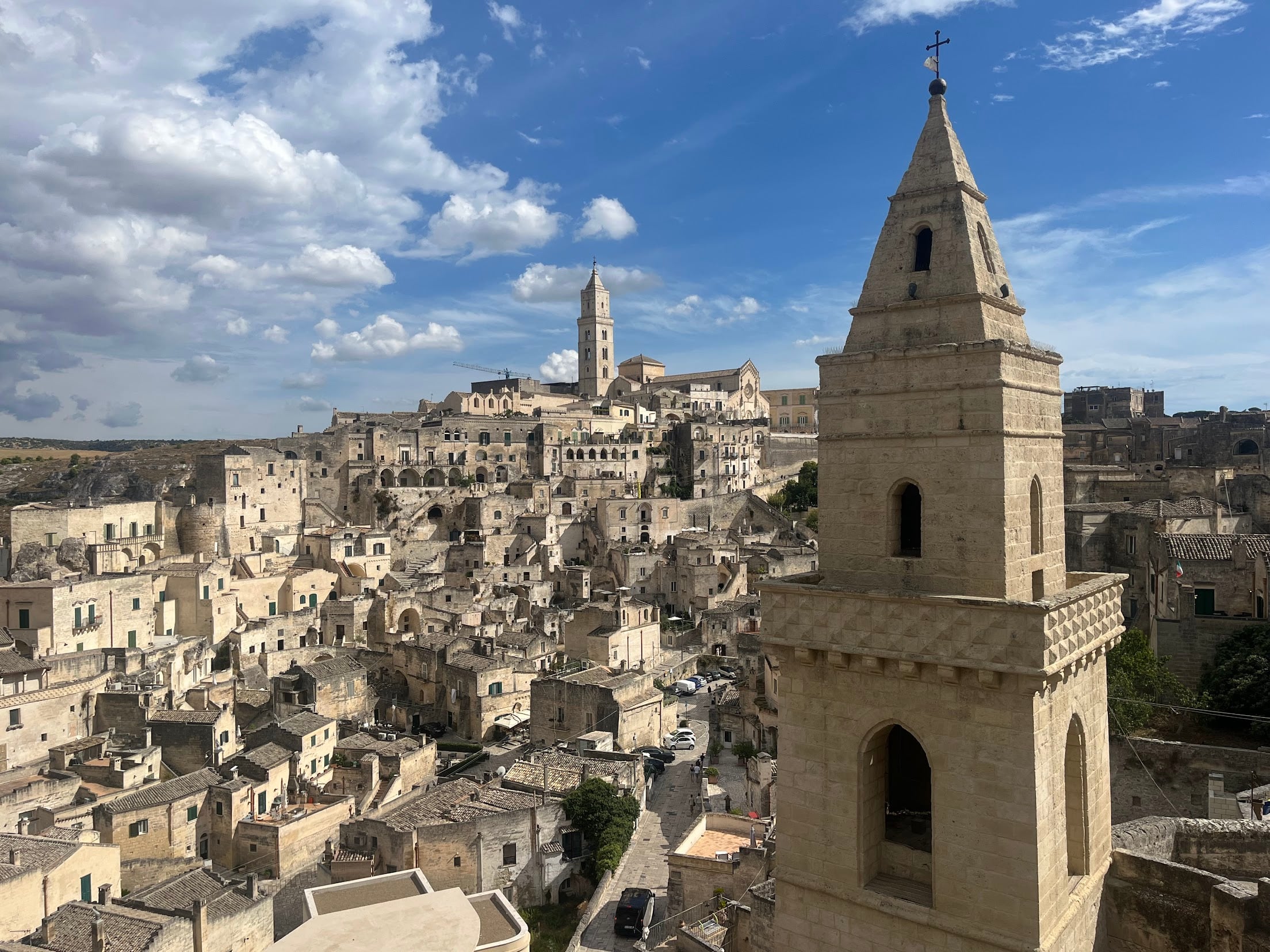
The Sassi are two districts of houses, churches and stairways carved into and built out of the limestone of a ravine, inhabited more or less continuously for thousands of years. They were emptied out in the 1950s after the conditions there became a national scandal, and then slowly brought back to life from the 1980s onwards. It is now a UNESCO World Heritage site and was a European Capital of Culture in 2019.
None of that quite prepares you for standing above it. The whole thing is one colour, stacked up the far side of the ravine in layers, with the cathedral bell tower at the top. Go in the afternoon, walk down into it rather than looking at it from the terraces, and wear something other than cycling shoes. It is stairs all the way down and all the way back.
A last night in Lecce
The flight home went from Brindisi, and Lecce is only about 40 kilometres further south. Rather than drive straight to the airport, we spent the last night there and came back up in the morning. It cost almost nothing in time and turned the travel day into an evening in a city.
Lecce is built out of pietra leccese, a soft local limestone that carves almost like wood, and the result is a city centre covered in baroque stonework of a kind you do not see elsewhere. The facade of the Basilica di Santa Croce is the showpiece. In the middle of it all, in Piazza Sant'Oronzo, there is a Roman amphitheatre sitting several metres below street level, half excavated, with the modern city built right up to the edge of it.
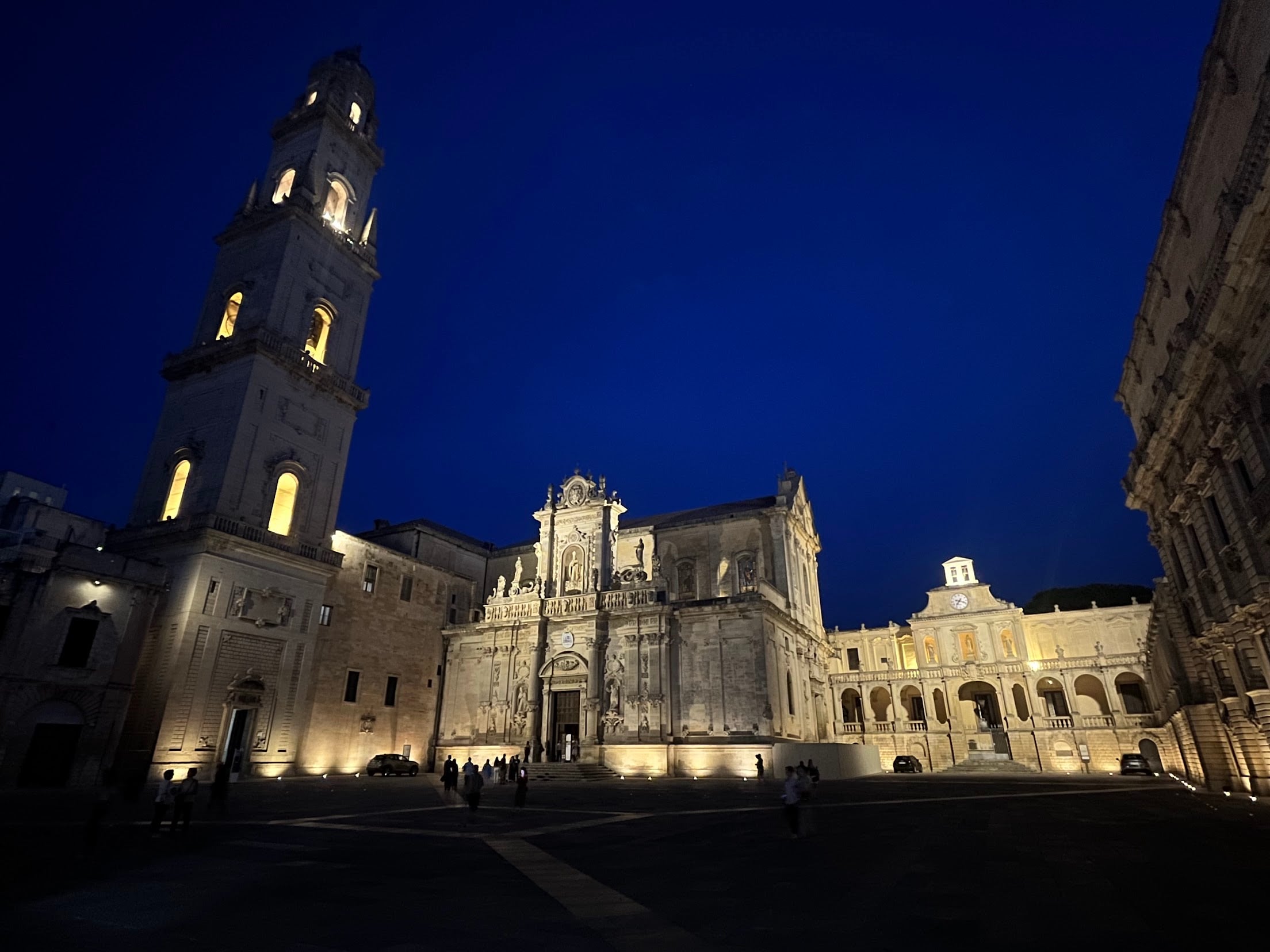
Piazza del Duomo is the one that stopped me, though. It is a closed square with a single entrance, so you turn a corner off a narrow street and the whole thing opens up at once: the cathedral facade, the seminary with its loggia, and a bell tower that goes up about seventy metres. Stay until the lights come on. The stone turns the colour of butter.
If you are flying out of Brindisi anyway, do the same thing. An extra night costs you nothing except a slightly earlier start on the last morning, and it is the difference between seeing Lecce and passing through it.
Doing this yourself
The practical version of the week above, for anyone thinking about the same trip.
Where to base yourself
Somewhere between Cisternino, Locorotondo and Martina Franca. Inland, on the plateau, not on the coast. Check the wifi before you book if you have to work, and take the rental car.
Getting there
Brindisi is the closest airport, roughly 45 minutes from Cisternino. Bari is the bigger one, around an hour and a quarter away, and usually has more choice. Matera is an easy day trip from the same base. Lecce is better as a last night on the way to the airport than as a day trip.
The bike
Rent locally. Probike in Monopoli looked after me well and is worth the half-hour drive. A gravel bike with generous tyres is the right choice, and not only because of the gravel: it is also what you want under you on the broken tarmac, which is most of the quiet riding here. If you specifically want the rougher trails on the escarpment, ask for a mountain bike instead.
When to go
September worked well: the coast had emptied out, the towns were calm, and the riding was warm rather than punishing. Spring should be at least as good. High summer would make the afternoon half of this plan fairly unpleasant.
What to expect from the riding
Short, constant ramps rather than real climbs, apart from the escarpment itself. Plenty of it is unsurfaced, and some of that is rougher than the maps suggest. But the tarmac is the real story: a lot of the small lanes are paved and in an appalling state, cracked and patched and in places worse to ride than the gravel next to them. The well-surfaced roads are the ones linking the towns, and you do not want those either, because better tarmac buys you traffic and the drivers here move quickly. Bring more water than you think you need, because the villages are small and the bars keep their own hours.
A week of this leaves you with maybe 140 kilometres in the legs, which is not a training block by any measure. But I worked five normal days, rode three genuinely good routes, saw two cities I will go back to, and came home rested.
The thing I keep coming back to is how little of it was planned. I booked late, turned up with one cycle path bookmarked and no real idea of what the rest of the riding would be like, and rented a bike from a shop I found the week I arrived. Some of that was luck. But a good part of it is just that this corner of Puglia is set up to absorb that kind of trip: short distances, quiet roads, a town worth stopping in every fifteen kilometres, and nothing far enough away to need a plan. If you have been putting off a week like this because you have not researched it properly, that is not the obstacle you think it is.
Hendrik Bulens
The average cyclist exploring cycling routes worldwide, particularly in Andalucía, Spain. Sharing expert guides on scenic bike routes for regular cyclists planning their next adventure.
Ride these routes
Routes from the area mentioned in this article.


Ciclovia dell'Acqua loop
A very fun loop from Contrada Marangiulo via Cisternino onto the Ciclovia dell'Acqua: traffic-free gravel, ever so slightly downhill, past the Galante bridge and countless trulli to Ceglie Messapica, then back north on narrow broken lanes and gravel through the olive groves. Hilly all the way, no killer climbs.


Smeraldo Trail loop
A popular Komoot mountain bike loop from Cisternino down the Murgia escarpment towards Ostuni, past Santa Maria di Agnano and the Sant'Oronzo sanctuary. Red dirt roads through ancient olive groves and great views of the coast and the white city. More adventurous than advertised, with a good 10 to 15 km of pushing on overgrown and rocky trails.


Dune Costiere run to the sea
From the trulli country around Cisternino all the way down to the Adriatic and back. Quiet lanes between drystone walls drop 380 metres past the Dolmen di Montalbano into the olive plain, then reach the beaches and dunes of the Parco Naturale Regionale Dune Costiere at Pilone. A bit of everything underwheel: good tarmac, bad tarmac, gravel roads, dirt and sand. The return is the sting in the tail, a long gravel drag through Speziale and a 2.4 km climb at 7% back up the escarpment to Caranna.
Related Articles
A week of workation in Puglia
A week of laptop mornings and gravel afternoons from the olive groves near Cisternino: three rides in the Valle d'Itria, half a day in Matera, and a last night in Lecce.

10 epic road rides in Andalucía
Discover 10 epic road cycling routes in Andalucía, Spain. Perfect for scenic rides, challenging climbs, and unforgettable cycling adventures.

My first bikepacking adventure
2 days and 1 night: the Vía Verde del Aceite. I share my experiences and the lessons learned after my first bikepacking adventure.